Thursday, May 21, 2015

Always Check ALL The Trails

While we were in Pisac, during the first weekend of the Maymester, we travelled up a mountain to visit ruins of an Incan city. We drove up to the top of the mountain, and after touring the ruins, we hiked back down. We hadn’t gone too far when we followed an arrow to find ourselves stuck on a trail, with a few different options to get down to the next ruins and the rest of the trail down.
The first was a steep, narrow trail that was lined with cacti. It was basically straight down the side of the mountain, and you could barely see the trail unless you were standing right in front of it. At the time we found the trail, we thought it might be the only way down the mountain. We debated for a bit about trying to go down that way, but ultimately decided that it was too dangerous and turned back.
Not too far away, we found another trail. Unlike the first one, it wasn’t lined with cacti (although there were a few on the sides) and it wasn’t quite as steep. We decided that this trail had to be the easier one, so that was the one that we chose. Still, we had to climb down carefully, one by one, and at times I, at least, had to crab-walk down to make sure that I kept my balance. It was rocky and pretty steep, but all in all not too awful to get down.
So we got down to the ruins, having climbed down the easy trail, right? Wrong. The second we reached the ruins and looked around, we could see a nice, wide, gently sloping trail that we could have easily walked down in at least half (probably a third) the time, if we had just gone a little farther past the second trail.   

Overall, the hike wasn’t too difficult. Once we reached our fiftieth flight of stairs to go down, I was ready to ban stairs from the world in general, but in my opinion, the view definitely made it worth it.

Wednesday, May 20, 2015

Rules for negotiating with locals

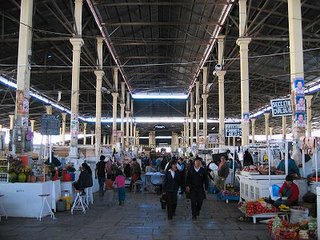
Since first arriving in Cuzco, I've been introduced into a minefield of shady bargaineers and street vendors attempting to peddle their wares. It started outside the airport, with local "businessmen" offering me cheap and safe taxi rides into the city center. Calle Choquechaca, the street on which our hotel is located, is not immune from these people, and I soon came to find that not only Cuzco, but most of the smaller towns we visited as well (such as Pisac, Chincherros, and Aguas Calientes) had thriving economies based on, one could say, quasi-legitimate business practices. 

So, I figured, if you can't beat 'em, join 'em. I caught up on some Pawn Stars, went to Cuzco's central market, and made myself a student of the art of the deal. I've had some success, some failure, but I've definitely learned a lot. So, without further ado, here are some rules for negotiating in the city at the top of the world:

1. When someone calls you "amigo," they're not really your amigo. With the amount of "friends" I've made on the streets of Cuzco, I should have the most popular Facebook page since Kim Kardashian. I don't though, and I quickly learned that in Peru, "amigo" is a synonym for "sucker."

2. On a similar note, unless you're shopping in a high priced, reputable shop, nothing, and I mean nothing, is ever 100% baby alpaca. If we're being honest, it's probably not even 50% alpaca. I've been offered alpaca scarves, gloves, sweaters, blankets - the works - all for less than 20 soles. The price of a real alpaca scarf would be upwards of 70, so if the price doesn't seem right, the vendor is probably - definitely - lying. 

3. Don’t be afraid to lowball. The first offer the vendor gives you will almost always be exorbitantly overpriced. Letting them know you’re not having it isn’t always a bad thing, and while it may insult them, it’s not like you’re ever going to see them again. I got a very nice sweater from Cuzco’s Mercado Central with this tactic.

4. Sometimes, the best way to get a bargain is to just pretend you can’t afford what they’re asking. I was in a very reputable store in Pisac negotiating for an actual alpaca sweater, and got them to come down 100 soles just by playing dumb.

5. Finally, it’s sometimes better to just not make eye contact. I learned this the hard way in the Plaza de Armas, where “Javier” and his good friend “Pablo Picasso Jr.” made my promise to come buy one of their hand painted, original works of art. Needless to say, Javier and I haven’t seen each other again, but it was quite the hassle telling him I didn’t want his painting. If you see a guy with an Atlanta Braves hat in the Plaza, I’d suggest walking the other way.


And, that about wraps it up. I’ll keep everyone updated on my continuing adventures in Peru, my ever increasing treasure trove of gifts and trinkets, and my increasing skill in the art of bargaining as the trip goes on. 


The art of buying


One of the first things I learned about Peruvian culture was how shopping in Cuzco is a bit different than shopping in the US. While there are certainly bustling supermarkets that offer a variety of products, there is a ubiquitous presence of vendors, shops and food stalls that line the streets, enthusiastically suggesting you to examine their 100% baby alpaca-wool sweater or try their freshly prepared delicacy. As I walk from one destination to another, I am constantly lured in by the aromas and colors each stall offers but I remain guarded and skeptical about the quality of many of their products. I have never been a big shopper and throughout all of our visits to different towns, all I have managed to buy is simple necklace for 3 soles at a local market in Pisac that signifies the different levels of the upper world, surface world, underworld; the sacred animals of the snake, puma, condor; the affirmations of don’t steal, lie or be lazy; and the respective elements of air, earth, water and fire. Not a bad deal I suppose as I always been more into the meaning behind artwork and jewelry than its actual flashiness. My forays into the market have taught me that bargaining and haggling are okay, in fact, even expected. Having visited China a couple of times where the streets are equally bustling and crowded, this type of rugged salesmanship is not new to me but I find it equally rewarding. At one of the markets we visited during our five day trip that culminated in Machu Pichu, I was interested in buying a sweater from an elderly lady. The starting price was fifty soles. While that really isn’t that expensive compared to brands in the US, I feigned disinterest and disbelief, saying things like “Tengo suéteres suficientes.”  I gave a counteroffer of 30 soles, which seemed ridiculous but when she lowered her price to 45, I held firm. While she eventually offered to sell the sweater for that price, I decided against buying it. Still, it is empowering to be able to walk around local markets, suggesting prices you think are reasonable. The casualness of bargaining and talking with the stall owners is so interactive and fun that even when I have no interest in buying something, I will ask them about a certain piece of sculpture, necklace or cloth just to see how cheap I can get the item for. If nothing else, the constant haggling has been one of the ways I’ve been able to practice talking with local natives. 


Tuesday, May 19, 2015

Who let the dogs out? PERU-RU-RU-RU!

One of the first things I noticed after arriving in Peru was the overwhelming presence of stray dogs. During my layover in Lima, we had to leave the airport and reenter before getting to our next gate. In just the minute or two outside I saw at least two stray dogs wandering around. After being in Cusco for about two weeks now, I think I can pretty confidently say that it is nearly impossible to be standing in any spot outside and not be able to see a dog somewhere around you. I was also surprised to see such a variety in the breeds of the dogs: little Chihuahuas to huskies and everything in between. During the day the dogs are more docile: they either roam around mostly staying out of the way or they find a nice spot in the middle sidewalk to lie down (completely unfazed by the people forced to walk around them). At night, it is like the dogs rule the streets. They travel around in packs, playing with each other and patrolling up and down the streets. One night I tried to take a picture of one of these dog friend groups, although it didn't turn out too well it still gets the point across:

5 dogs hanging in the streets of Cusco (plus one behind the planter)

Profe Falconi explained that it is considered inhumane to neuter dogs here so they reproduce a lot. Additionally, many people here get dogs as pets but then once they realize how much work dogs require, they often release the dogs to the streets. The combination of these two points helps explain why there are so many stray dogs. At night it is fun to watch the dogs as they run around in little packs, waiting for each other when one stops to sniff something, like little makeshift families. In the U.S. you don't see many stray dogs and I think overall if someone did, their attitude towards the dog would be one of sadness and maybe sympathy. Here the stray dogs are often treated like rodents. When we were exploring Ollantaytambo we stopped around a few stores and several of us sat along a stone wall. While we were there a stray dog wandered over and sat at my feet. I was not going to pet it or anything but I also didn't try to scare it away. Later when we left, a nearby lady who was selling cow heart skewers went after the dog with her knife out to scare it away and it was in fact scared and left. This difference in perceptions of dogs is similar to the different perceptions of guinea pigs in the U.S. and in Peru. The idea of animals being perceived differently in different countries is something we see all around the world and something that makes each culture unique.

Irregular Regularities

This post was intended for Thursday, 5/14, but due to spotty wifi is first being posted now:

Today was an absolutely incredible day. I don't know how anything could outdo today's experiences (keep in mind this was written before we visited Machu Picchu), and am a bit worried that the rest of the trip will be disappointing in comparison. I mean, how often do you get to eat the potatoes you harvested with your own two hands? Better yet, how often do you get to stand under what must have been a 100-foot waterfall after hiking to it on a steep, hidden trail for two hours? Apparently, for the people of Chincherros, these are everyday occurrences. Similarly, if the family who hosted us were to visit us in America, they would probably be amazed by our everyday experiences that for them are rare. For example, I think that if Fiorella ever came with me to one of New Jersey's huge shopping malls, she would have a similar reaction to that of mine when I stood underneath the magnificent waterfall. Overall, as much of a service that the host family did for us, I think that we equally helped them. Our excitement about harvesting and hiking reminded them not to take anything for granted. I could tell that they were somewhat shocked by how impressed we were with everything. What I took away from this? When we get back home, I hope to live my everyday life with the same passion as picking up that first potato.

The waterfall we hiked to

Cooking the potatoes we harvested through a process known as "Huatia"

Chac-chu Picchu

Back in March, when I was talking to my friend/former housemate/housemate-to-be, and avid Chaco enthusiast, he heavily encouraged me to get some Chacos for the Maymester and for life in general. He would tell me all about the points of the shoes; they’re Vibram soles; they have models with or without toe straps; they can be “re-Chaco-ed” for 25 bucks and get them cleaned and get the straps replaced. And after some heavy convincing, I finally caved in and bought some. Since May 5 when we got to Peru, I’ve been wearing nearly exclusively Chacos every day, whether I’m hitting up Paddy’s Pub, walking to class on the cobblestone streets of Cusco, or hiking up Machu Picchu, and they’ve served me incredibly well for each and every task. The only gripe I have had with them is that I got a ton of bug bites while at Machu Picchu, but that’s my fault for not using bug spray. It’s also just a minute price to pay in exchange for the sweet Z tan that’s now imprinted onto my feet. Everyone else on the trip has been wearing hiking shoes or hiking boots and here I stand, strapped in for the ride, wearing Chacos day in, day out, feeling the wind between my toes. Chac one up to nature.
Swaggy Z tan and some bug bites

How I was brutally assaulted by tap water

As previously mentioned in Linus’ post, I ended our trip back from Machu Picchu by sprinting out of the bus and puking on a Cuzco street.  This blog post will be dedicated to telling this unfortunate story.
            I cannot pinpoint exactly what forced this plague upon me.  When I was on a trip to Senegal during my sophomore year of high school, one of my classmates came down with the same sickness after ingesting tap water, so I am going to assume that this is what happened to me.  I had brushed my teeth and cleaned my retainer with tap water (instead of bottled water) the night before for the first time this trip and woke up with an upset stomach.  I was not going to miss our tour of Machu Picchu, so I sucked it up and dealt with it.  I felt good enough throughout the day until we boarded our bus in Ollantaytambo (below Machu Picchu) that evening.  At this point, my stomach started to really hurt.  Still, I just pinned it on indigestion, popped some Tums, and boarded the bus. 
Things soon took a turn for the worst.  My body got incredibly hot and my stomach started to feel queasy.  I tried my best to stay still, hoping the feeling would go away, but I was soon forced to ask the driver to stop the bus so I could hop out.  I did not puke at this point and the fresh air made me feel a bit better, so I assumed that the worst was over.  However, 20 minutes later, I found out that this was not the case, as I was once again forced to stop the bus, this time in Cuzco.  This time I did puke, all over the sidewalk.

I was able to make it back to the hotel, but was soon met with more feelings of uneasiness and vomiting, which lasted the entire night.  Moral of the story: avoid the tap water at all costs or you will end up like me.

A Cuzco street that probably looks like the one I got sick on

The Trip to Písac

     After about three days in Cusco, Peru, Professor Falconi told us that we were going to be heading to a town called Písac. The previous year I had spent a month in Quito, Ecuador, and the town of Cusco seemed very familiar to me. As a result, I was under the impression that the towns would also be similar that we were going to visit in Peru. Fortunately, I was completely wrong. We took a fairly short bus ride to the town of Písac, and I remember waking up and looking down a vast valley. At the bottom was a small town surrounded by mountains that I believed would be an incredibly interesting town to stay in and spend a day or two. To my luck, as we descended into the valley, it ended up being our final destination. We arrived in the center of a market filled with kiosks owned by the residents selling various items such as: scarves, sculptures, and alpaca stuffed animals. I remember being incredibly excited about our stay, and I can explain why.
     Down in the valley was considered to be the colonial Písac, and along the side of one of the mountains were the ruins of the Inca city of Písac that was built in the 15th century. In order to get up to the ancient city, we took a bus ride to the top of the mountain and walked around with a guide that showed us the ruins. She explained to us the function of some of the houses, as well as the purpose of the many terraces we saw. From the guide, we learned that mostly members of the military lived high up in the mountain, and the terraces were built in order to allow for crops to grow in high altitudes. Overall, our stay in Písac was an amazing time as we were then able to hike down from the Inca ruins back to the town down in the valley. Furthermore, it allowed us to experience distinct differences between the ruins and the town that many tourists visit to engage with the locals and experience the well-known market.

Below are two pictures that I took during our stay. The first one is on the roof of our hotel that showcases our surroundings, and the second one is a view from the Inca ruins that overlooks the town below.

Depth: The Photographer's Struggle

One thing that we run into, no matter where we are in Peru, is the high number of amazing sights. There are such great views wherever we go, whether it's on our street, Calle Choquechaca, or maybe even climbing all the way to the top of the city to see all of Cusco. Mountains, lights, and more cannot fit into just one single picture! What our eyes see is breathtaking and I just haven't been able to capture the same amount of amazing through my camera, so it definitely has been a struggle. Mountains that look huge to my eyes cannot be portrayed with the same depth on the screen. I guess it's true when they say "seeing is believing." I will definitely need more practice but I just feel like I'm not doing justice to the beauty that is the country of Peru. 

Overall though, taking pictures of the area is so fun. There are so many landscapes, buildings, people, and dogs to take pictures of. Machu Picchu was one of the most amazing experiences for me and there were times I could not believe what I was seeing through my viewfinder. Some views are so crazy, that when I take a picture of someone in front of it, it looks like a green screen view. It essentially looks fake! That's how picturesque the views here are and hopefully, I'll be able to grow as a photographer here even more and truly do justice. 

The below photographs are some sample shots that I took during our first week, and while they do look magnificent, they looked 5 times better in person.