Sunday, May 22, 2016

Ceviche All Day


When you think of the word ceviche, what exactly comes to mind? For me, ceviche entails something of a certain elegance or level of richness only found at the highest quality restaurants in the United States. I may be making an overgeneralization, however, I find that most Americans view ceviche the same way I do- as a dish not eaten daily. However, after spending a few days dining throughout Lima, I have found that ceviche has a different meaning to Peruvian culture. I always said I could eat ceviche for breakfast, lunch, and dinner; Well, in Lima I practically did. Ceviche is almost embedded in Lima’s natural daily cuisine. Peruvians view ceviche not as a selective dish, but rather as a commonality found on many restaurant menus’.


When we took a cooking class at el restaurante El Bolivariano in Lima, their Peruvian chefs taught us how to hand-make a classic ceviche dish. The simplicity of the ingredients used to make Peruvian ceviche took me by surprise. As I looked at the ingredients in front of the chef, I saw simply cut peppers, onions, ginger, tomato, corn, and basil along with salt, and a simple homemade sauce tasting primarily of lime. The chef mentioned that the specific type of fish used didn’t matter as much as the technique of filleting the fish. She then mixed the filleted fish in a bowl with the sauce and equally proportioned spoonful’s of each ingredient and plated the finished masterpiece. Hand-made ceviche can obviously not be mass produced, however, I found the preparation to be rather simple and easy to follow. The chef at El Bolivariano, to me, disproved an American stereotype about ceviche. Perhaps the name ceviche itself gives it a type of elegance, but in Peruvian culture this dish can be found everywhere and at a decent price I may add.  

Lima has desert not just dessert

I had many misconceptions coming to Peru – that there were not any large modern cities, that llama and alpaca were two names for the same animal, and that the entire country was either coastline or highlands. I was completely unaware of the huge desert and lack of rain that permeate so much of the country, including Lima. When I began to consider what I should discuss in my first blog post, I thought to what questions baffle me the most. While not a particularly sexy question, I had never seen a coastal desert and wondered how that was possible given what I knew about the forming of normal deserts. Furthermore, I was always intrigued by how these huge cities and civilizations developed when a large part of the area received no rain and why. 
The first question was answered by our first tour guide Ronaldo as we travelled throughout Lima. The waters of the Pacific off the coast of Peru are an intersection point for two currents, one of them being the Humboldt. This current is unique due to the influx of cold water it brings right off the coast, which has the effect of sucking moisture out of the surrounding land instead of providing it with rain, creating a coastal desert.
The second question proved to be less straightforward and more subject to interpretation, but also far more interesting. Ancient cultures in the South American deserts, from the Sechura to the Atacama, used different techniques for acquiring and storing water for the dry seasons. Lima relies on glacial runoff and other means to get its water, but another method was via lomas, oasis-like pockets of vegetation that emerge during July and November. These acted as life lines for animals and populations by the trapping of fog created by the same Humboldt current that creates the coastal deserts in the first place. These lomas have been declining recently due to deforestation and global warming, causing people to turn back to other techniques, some ancient in nature. One plan involves refurnish old structures called amunas originally constructed by the Wari people, which allows rainwater to sink into the ground and highlands instead of flowing all downstream, creating a store of water that resurfaces during the dry season.

Urban Planning in the City of Cuzco

My first impression of Cuzco was that it reminded me of Toledo, a medieval town in Spain. I adored the cobblestone streets, old churches, and archways that surrounded the main plaza, called La Plaza de las Armas. However, yesterday myself and three other students decided to stray from the main city center and walk uphill, to see what could be found towards the less touristy areas of Cuzco. What I observed on our stroll was that although La Plaza de las Armas is an obvious meeting place and hangout spot for tourists and native Peruvians alike, it was not the only part of the city which aims to serves tourists. That is to say, I realized that Cuzco was unlike other cities I had experienced, in which there is a designated touristy area with hotels and shops. Conversely, as we walked farther and farther from the bustling plaza, I noticed that although we were obviously getting into a more residential area, there were just as many hotels and hostels lining the streets. As I peered down a street from the main drag we were walking on, I saw this:


It appeared that unlike cities in Europe, such as Paris or Madrid, there was no major distinction between the tourist and residential parts of the city. It actually seems that (outside of the area immediately surrounding La Plaza de las Armas) the main streets are lined with hotels, shops, and restaurants (aimed mostly at tourists) and the local people of Cuzco live off of these main streets, usually up into the mountains a bit. I think this sort of urban planning was very smart for a city that sits amongst mountains, because it enables a few major streets to contain tourist attractions, while still allowing the locals to live in all parts of the city. If Cuzco were to be separated into district-like areas, as many large cities are, I think it would force the native peoples to live in concentrated urban areas, for economic reasons. This is turn would create more poverty and less opportunity for integration and interaction between CuzceƱos and foreigners. For example, separating these groups would mean that many older women in particular could not get to the touristy part of the city to sell handmade goods, whereas since they live on an offshoot of a main street, they are able to easily walk a few blocks and make their living selling their products. Although it seems to be obvious once you think about it, I admire the foresight of urban city planners in Cuzco for taking into consideration the lives of local Peruvians in the midst of creating a city plan that is conducive to tourism.

Friday, May 20, 2016

Talk Church-y to Me

     One of the most beautiful things about the Mass is that it is the same in every language across the worldwide Catholic population. With this in mind, I attempted to follow the flowing romance language that accompanied the parts of mass I've come to know well, while also attempting to follow the standing, sitting, and kneeling of Peruvians around me.
     Sadly there were too many differences in translation for me to say anything except "y con tu espĆ­ritu" and start the "nuestro Padre" only for Profe. to correct me that it is "Padre nuestro." Another line that stood out as different in translation was that in English we say "it is right and just," where the Peruvians said "es justo y necesario," which has a slightly different meaning.
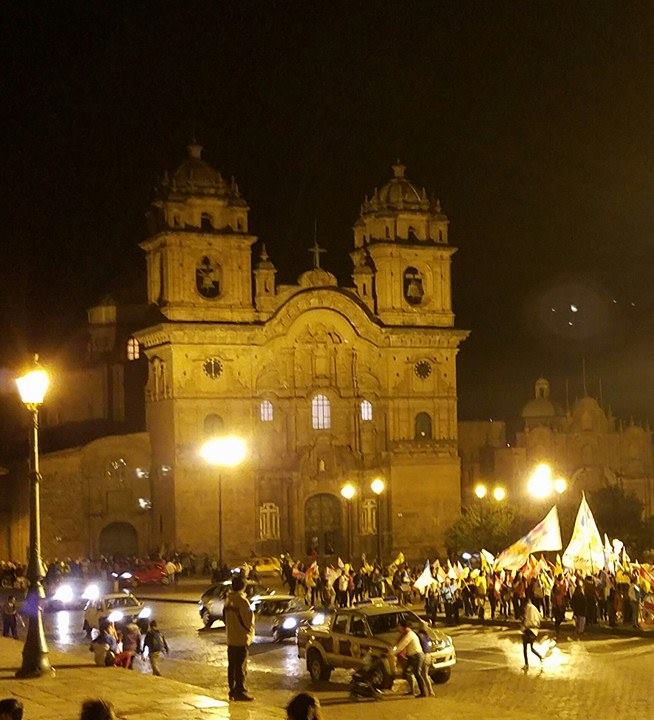
      As it was a Monday evening service at 6 PM in La Iglesia de la CompaƱƭa de JesĆŗs (a Jesuit church) in La Plaza de Armas here in Cusco, the turnout was not very high for such a large Cathedral. However, there was still an array of ages in the church, and most people were dressed very casually, though the priest was in his vestments that looked the same as any in the US. People offered one another the sign of peace with either a handshake or hug as at any other mass, but there was none of the music or chanting I was used to, and it ended up being the shortest mass I've ever been to, clocking in at almost exactly 30 minutes.
     In comparison, last night we briefly popped into a (what Profe. called) "peasants' mass" in Pisac and got to hear festive singing as part of the service. This is from the mix of Catholic layered on top of the old Quechua rituals, keeping some of that celebratory aspect where Catholic masses are usually drier.
     The main thing I've learned from attending mass here though is that I really need to look up the order of mass in Spanish before I go again, because it's very awkward when you're sitting in the second row with Profe. and Alejandra on either side reciting everything word for word in perfect Spanish. Amen.

LIFTOFF IN LIMA


                                                          LIFTOFF IN LIMA
                                                          By Charlie Hawkins
It's day one in Lima and I can feel the energy as this trip gets underway. The drive to the Hostal Killari was scenic, as a cross shined on top of a cliff over the Pacific Ocean in the night sky. The smell of ceviche and pisco sour fills the warm Peruvian air. Love Park known as the Parque de Amor was a lovely sight on our first day touring Lima. Shopping has commenced in Lima, as people are eager to bring home souvenirs, and San Antonio has been the spot for our group, having eaten there twice. Hostal Killari serves a killer breakfast of eggs and bread every day, which tastes better than the sand that many people consumed while sandboarding down the sand dunes of the Peruvian desert. Getting our feet wet through experiencing the culture and history of Peru's capital has been a great introduction to our Maymester. If the trip is anywhere close to as good to me as my new argan oil has been, I can say with confidence that this trip was a Maymester worth taking.


Product view


Tuesday, June 2, 2015

Peruvian foods I will (and won't) miss

In one month in Peru, I can safely say I’ve tried quite a list of foods and drinks I never even knew existed. This was obviously very exciting for me, and I’ve developed a number of new favorite dishes I can’t wait to try again. At the same time, there are a few I’ll have no problem never tasting again.

Foods I will miss:

1. Lomo Saltado

The lomo saltado is nothing short of legendary. It is a stir-fry, in which beef, tomatoes, peppers, and onions are blended in a pan with soy sauce and fried potatoes. It is perhaps the most popular dish in Peru, and easily my favorite.


2. Anticuchos

While I may have been the only one on the trip to try these, I am certain everyone else made a huge mistake. I had my first skewer from a street vendor for just 2 soles, and there was no looking back after that. Usually made from cow hearts, anticuchos are cheap and absolutely delicious.

3. Palta Rellena

It’s hard not to make something good when avocado is the main ingredient, and the palta rellena is no exception. It is basically half an avocado stuffed with whatever the chef feels like. It is always delicious.


4. Pisco Sour

The GOAT of Latin American cocktails. Order a pisco sour (or seven), sit back, and enjoy.


Foods I won't miss as much:

1. Andean Cheese

Just don’t. Everything else on this list you can try and see for yourself, but do yourself a favor and just don’t try andean cheese.

2. Mazamorra Morada

The best description of this lovely dessert came from one of the members of our trip. He describes it as “corn/robitussin/melted candle/3rd party off brand gummy bear plasma.” Take that as you will.

3. Chupe de Camarones

There’s nothing I love in this world like shrimp and prawns, but this soup is one of the only things hat can make me hate them. Imagine a bowl of milk, hot sauce, and shrimps. Now throw in a hard boiled egg and some of that good old andean cheese. Now some more milk. You have yourself a chupe de camarones. Buena suerte.


4. Inca Kola

Look, I’m all for Peru having its own signature soda, but if I really wanted bubblegum flavored toothpaste, I’d go back to my 7th grade orthodontist.

The Day I Climbed a Skyscraper

     The highest altitude we reached during our trip was the town of Chinchero, where we stayed for a couple of nights. The town is situated at a lofty 14,000 feet, quite a bit higher than Nashville. On our second day there we did a lot of walking, and I definitely felt the effects of the altitude. First thing in the morning, we got up and helped harvest potatoes out in a field down the road. When it was time to leave, we decided to hike the scenic route back, past a lake and through some other local farm fields. This would not have been too difficult of a hike for me down at sea level, but I was struggling a bit. However, that hike was just a warm up.


     After we got back and had lunch, we decided to hike out to visit some waterfalls nearby. We didn’t really know what to expect, as we had gotten mixed information about how long the hike would take. Regardless, ready for an adventure, we set off. The way there wasn’t too bad. It was almost entirely downhill, with only a few treacherous parts, and the views of the nearby mountains and valley were absolutely stunning, some of the best from the whole trip. After about an hour of hiking, we reached the falls. I was expecting the falls to be pretty cool, but they turned out to be incredible, way bigger than I had anticipated. They were at least 100 feet high and gave off a nice, refreshing mist. We rested there for a while and took in the sights, while Adam decided to be adventurous and take a dip in the water.


     The hike back was when things started to get tough. This time, the path was uphill. The “steps” didn’t help very much since they were still at a pretty steep incline and didn’t give your legs a chance to rest. Even at sea level, this would have been a difficult hike. However, being at 14,000 feet made things even tougher. It seemed like I had to stop every couple hundred feet or so to try and catch my breath. I would rest and feel ready to go, but not make it very far at all again upon restarting. Profe had it the worst out of all of us, as his body was not handling the altitude well at all. The trip back took over twice as long as the trip there, and we had to complete the second half of it in the dark since the sun set on us. This entire struggle was completely worth it though. The views from the trail were amazing, the waterfalls were incredible, the darkness of the backcountry gave us undisturbed views of the stars and planets above us, and it was great exercise. When I got back to the hotel, on a whim I pulled out my iPhone and checked the health app that tracks my daily activity. What I saw shocked me. I had climbed 106 floors. To put that in perspective, One World Trade Center, the tallest building in the US, has only 104 floors. So, I can say that on that day I climbed the equivalent of a skyscraper, and got better views. It is and experience that I will never forget.


Monday, June 1, 2015

Over the mountains and through the woods (and across the desert and ocean too)

     Before coming to Peru, I knew I was in for an adventure. I had never seen large mountains before (unless you count the Appalachian Mountains – I sure don’t now) and was really looking forward to staying in the Andes, namesake of one of my favorite mint chocolates and the longest continental mountain range in the world. Peru certainly did not disappoint. On my flight to Cuzco from Lima I was glued to the window as the plane passed over the mountain range. Upon landing in Cuzco, my jaw dropped as I took in the view. The city is surrounded by small mountains on all sides. I was thoroughly impressed, but things kept getting better from there. As we took our side trips all over the region we kept encountering taller and taller mountains and getting better and better views, including expansive valleys and towering snow-capped mountains, like the one pictured below.
     I fully expected to see mountains during our trip, due to my extensive Google searches of the Cuzco region during finals week as an outlet and means of procrastination. However, there was so much diversity in the geography of Peru that I did not expect to see. In Lima, I got to see the Pacific Ocean for the first time. The city perched on the cliffs overlooking the surfers catching waves was a sight to behold.
     Then, as if the mountains and ocean weren’t enough, we took a trip south of Lima, to the desert Oasis of Huacachina. Yes, desert. This trip also marked my first time being in the desert, which provided incredible views and tons of extreme entertainment. Riding in a dune buggy and sand boarding are up there with some of the most fun things I’ve done in my life. After all that excitement it was nice to lay back and watch the sun set over the dunes.
     Peru is incredibly diverse and home to many environments, animals, and cultures. I was able to experience a lot in one month, but know that there is still so much that I have yet to see and do. Visiting the rainforest and Lake Titicaca are on the top of my to-do list for the next time I visit Peru, which I absolutely would love to do.

Back in America but With a Peruvian Eye

I was driving with my mom on the highway when I noticed a large flatbed truck to our left carrying three huge pieces of cement. My legitimate first thought was "the Incas really could have used that." I sort of laughed under my breath after I realized that I would never have had that thought before the trip. Just a month ago I hadn't been thinking about the Incas, let alone how they transported the massive stones they used to build some of the architectural wonders we saw. It still absolutely amazes me that they were able to engineer such lasting buildings and terraces with such simple tools and I wonder what things they would have been capable of with the resources we have today.


The truck carrying the large blocks of concrete

The next day I walked into the grocery store with my brother to get some milk and oreos. In Peru I tried to stay away from drinking straight milk because of my history of lactose issues so I was excited to hopefully appease my stomach and get some good lactose free milk at home. Naturally my brother wanted to tag along to get some Oreos to go with the milk. Being summertime, there was a massive bin full of corn right when we walked into the store. I was immediately struck by how small the kernels were until I remembered that I had been thinking of choclo for a month and had forgotten how small the corn we are used to is in comparison. I am sure I will be in for another surprise the first time I take a bite of this corn, not quite anticipating the sweet flavor that I haven't had for over a month.


Our super small corn

I can say without a doubt that this trip has changed the way I think about things back home. Everything from our lack of freshly squeezed orange juice to seeing my dogs run around at home reminds me of the amazing experiences I had and the even more interesting things I learned. Until next time Peru!